Optimistic outlook despite tariff threats
We are currently witnessing a global economy that is volatile and unpredictable. It can be said that global trade conditions are being influenced by a variety of micro and macro-economic factors.
In particular, the threat of significant increases in tariffs, retaliatory tariff measures and the potential of an all-out global trade war is causing great uncertainty, especially within agriculture.
This predicament has caused the World Trade Organization (WTO) to project a potential 0.2% contraction in global trade, with tariff escalation potentially being even more severe at 1.5% contraction in 2025. This is a far cry from the predicted 3% growth estimate made by the WTO as late as October 2024.1
1 https://www.wto.org/english/blogs_e/ce_ralph_ossa_e/blog_ro_11oct24_e.htm
This uncertainty was echoed at IFFA 2025 as much of the discussions centered around the economic situation in the United States as well as the influence and impact the American economy has on costs
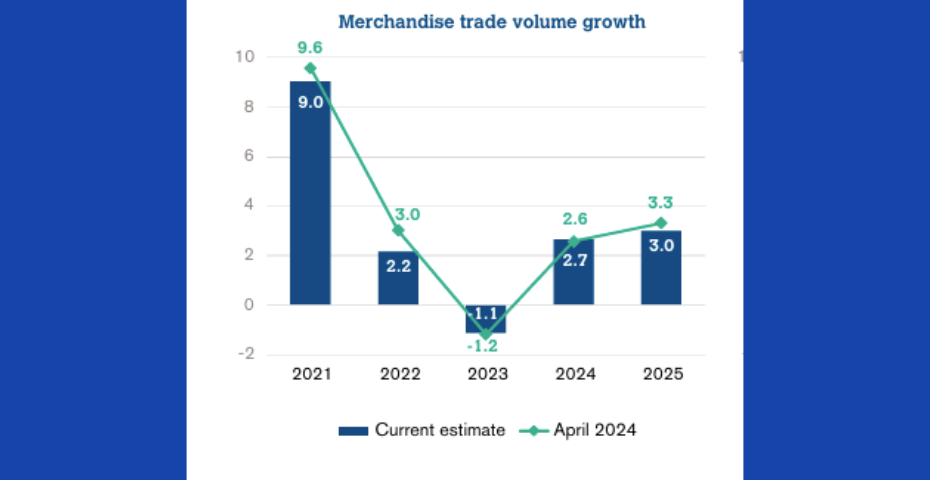
Figure 1: WTO estimate of trade volume growth between 2021-2025. 2025 highlighted with a 3% growth as late as October 2024. Source: WTO.
and profits margins for companies large and small beyond the North America. Rupert Claxton, Meat and Livestock Director at GIRA Consultancy and Research, gave his thoughts on the topic at IFFA 2025:
"When it comes to what people are talking about at the show this year, the first concern is clearly America and the impact that America’s got now on margins and the world itself.” ......“Do the tariffs come in? Does Europe retaliate? Where do we end up? So, the thing I think that sits at the back of everyone’s mind in the US, unfortunately."
With that being said, according to IFFA, more than half of visitors surveyed at IFFA 2025 expect the meat industry’s economic outlook to improve, while one-third believe it will remain the same. Nevertheless, the potential impact of tariffs and retaliatory measures will undoubtedly have consequences for all in the meat industry. 2
2 https://iffa.messefrankfurt.com/frankfurt/en/press/press-releases/iffa2025/iffa-2025-final-report.html
Perhaps in the years to come, the topic of discussion at IFFA will be geared more towards market diversification on tariff sensitive regions and capitalizing on emerging opportunities in the global meat market.
Artificial Intelligence (AI) comes of age at IFFA 2025
There is no doubt AI, Automation and Robotic technologies are fundamentally revolutionizing industries across the global economy. This notion was reinforced at IFFA 2025 with AI-supported data-driven process intelligence being touted as the future of the industry – this was echoed though the variety of industries demonstrating their latest AI-assisted technologies.
AI’s appearance in the meat industry has not been instant, but the advancements have sped up significantly in a relatively brief period. There are numerous examples of AI technologies being used effectively within the meat industry – for example, Precisions Livestock Farming (PLF) allows farmers via AI powered sensors to monitor and track parameters related to animal health and wellbeing – body temperature, heart rate to name a few. (See Figure 2 below).
While AI is also optimizing meat supply chains with custom-made algorithms analyzing large datasets ranging from sales figures to production quantities and historic demand to aggregate precise predications for supply and demand of product – resulting in a ‘leaner’ processing and production output. Those already benefiting from AI range from those in the food retail, packaging, butchery and even the spices industry.
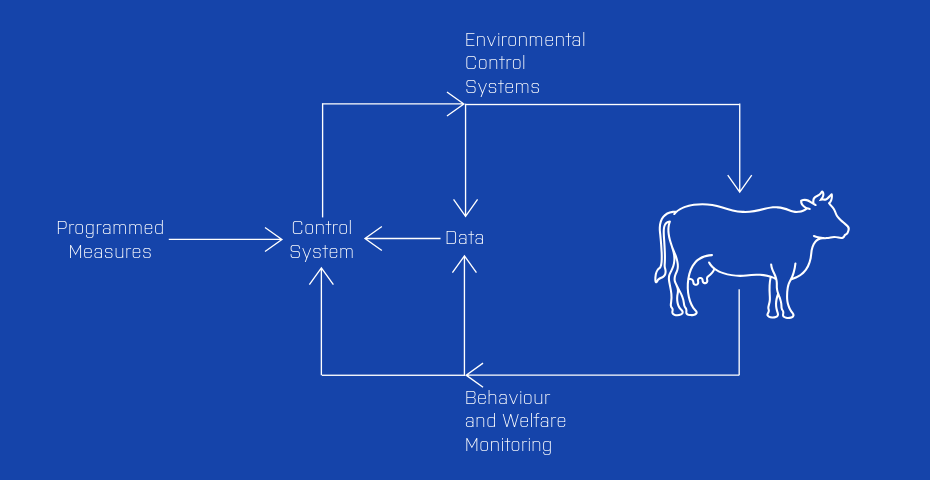
Figure 2: An example of Precisions Livestock Farming (PLF) in action.
At IFFA, there were over 1,000 exhibitors from more than 50 countries showcasing their machines, technologies and solutions that stretch the entire meat and alternative protein value changes, respectively.
FOSS was one of the exhibitors, showcasing a selection of our meat solutions to attendees.
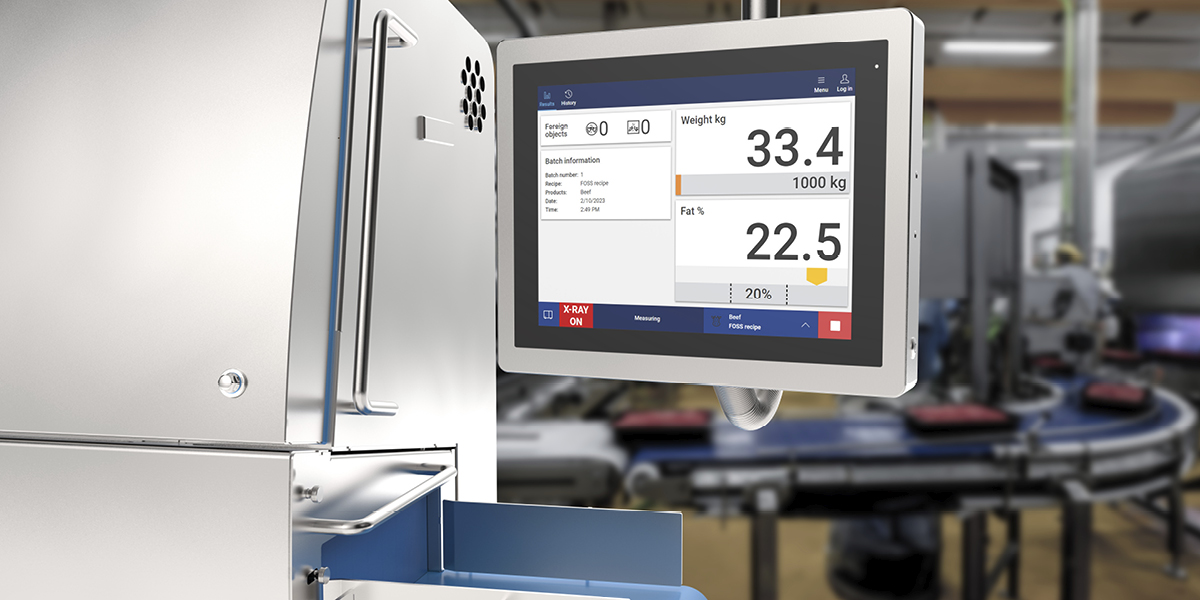
We showcased our recently launched MeatMaster™ Flex solution designed to fit immediately after the grinder. Its exceptional mobility makes it easy to integrate into any production facility, and the state-of-the-art X-Ray scans 100% of the meat with industry leading accuracy.
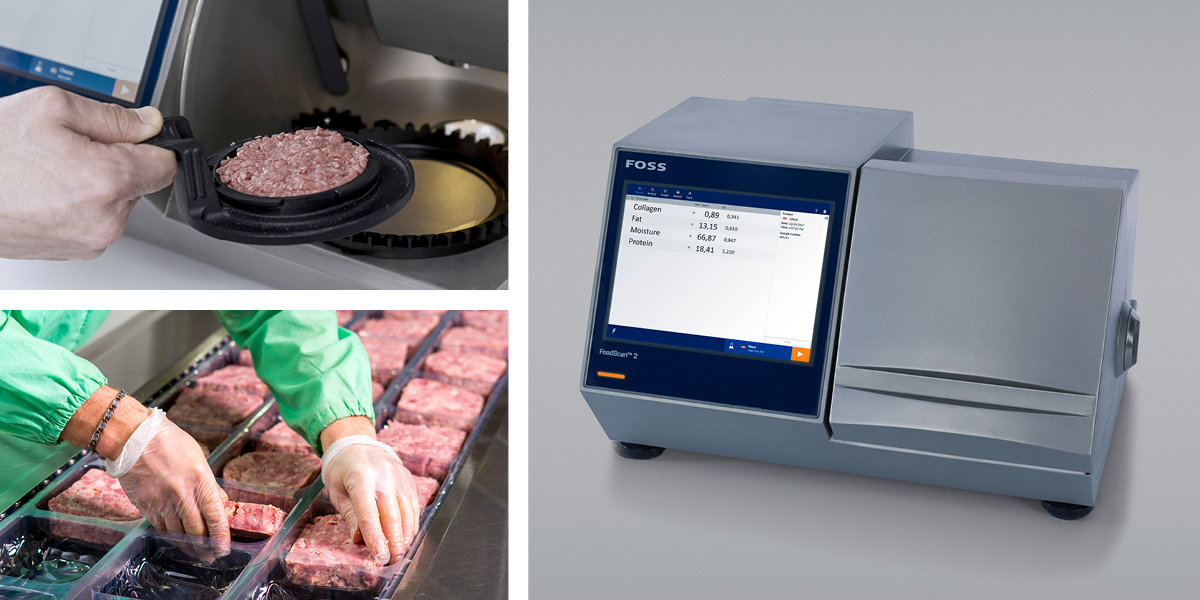
We also demonstrated our other X-Ray solution, the MeatMaster II™ as well as our NIR solutions. One being the FoodScan 2™, which with its wide choice of parameters can be used for QA of all types of meat products as well as alternative protein based ‘meat’ products.
With that in mind, what can be said is that digital technologies are rapidly developing - driven mainly because of a shortage of skilled workers and the need for a more agile and efficient processes.
These views were echoed by Kenneth Nielsen, Area Sales Manager at Oestergaard A/S - who

Figure 3: The FOSS booth at IFFA 2025.
manage/service large meat and fish by-product manufacturing units:
“In the rendering industry, we see bigger and bigger demand for better process control and getting better and more consistent products out of the line. It’s all about optimisation and that requires better analysis in order to know where you are.”
Peter Thomas Ricci, Managing Editor at MeatingPlace Magazine, suggests that IFFA identified and reinforced that Automation plays a key role in the industry when asked what he believed was the major talking point at this year’s event:
“…I would definitely say Automation, AI, the kind of things that help processors with labour challenges”.

Figure 4: MeatMaster Flex on Display at IFFA 2025.
However, he expands on a larger problem that AI and Automation have not been able to solve - the lack of a skilled labor supply in the meat industry:
“What we’re seeing in the United States is that beef especially tends to be operating at a lower capacity that what the plants can ultimately do. And it’s not a supply problem; it’s a labour problem – and having enough people there to actually function within the facilities.”
Specifically in the United States, Peter believes that a variety of factors over the past number of years have meant that skilled labor in the meat industry is difficult to find an even harder to retain:
“So [American Meat Businesses] they’re thinking, okay, how do we make this a job for life? How do we keep someone around longer than just a year, because we may not be able to replace them if they go to another warehouse job down the road.”
He believes companies must become "much more creative in worker retention in addition to recruitment."

Figure 5: Statistics from IFFA 2025. Source IFFA.
There is no doubt AI and Automation will continue to disrupt the meat industry, the potential for processors and producers to drive significant transformations across not just one part but their entire value chain has exciting potential for meat businesses around the world.
But there is also a word of caution – There is an absolute need to find and retain skilled workers long-term while competing in an extremely competitive labor market in countries like the United States.
Final thoughts about IFFA 2025
So, what are the key-takeaways from IFFA 2025? Today’s meat industry like others will continue to be significantly impacted by headwinds in the macro-economic environment and volatility in the geopolitical landscape.
There is no doubt, tariffs will have consequences for meat processors and produces globally, however the scale of these consequences are – as of writing, unknown.
Despite all of this, there are those in the meat industry who are cautiously optimistic about the future. Many see the rapid development and implementation of AI and Automation processes as mainly beneficial for the industry.
There is no doubt AI and Automation can make processing and production more efficient and cost effective. However, we must not forget the need for skilled labor in the industry, particularly recruiting and retaining a high quality and skilled workforce in a fierce and competitive employment market.
Looking to make your meat production as ‘lean’ as possible?
Get in touch with our specialists to discuss how reliable, real-time data can help you make the most of costly resources, minimize lean meat give-away and meet your target values every time.