The global livestock industry stands at a turning point. The pressure to reduce emissions, improve animal welfare, and enhance productivity has never been greater. But the path to greater sustainability must also make commercial sense for farmers and processors. FOSS is on a mission to make sustainability more manageable and measurable - to turn knowledge into action. With precision analytics, daily on-farm decisions can be connected to global climate goals, proving that smarter farming is not just possible, but practical, economical, and sustainable.
For this, FOSS has been honored by the Food and Agriculture Organization of the United Nations (FAO) with a Certificate of Appreciation for its innovation, “Precision Analytics for Climate-Smart Livestock: From Feed to Food with Cost-Effective Data. In this interview, we are asking Daniel Schwarz what is behind the innovation.
Q: Please tell us more about the awarded Innovation
A: The idea is simple: help farmers and food processors get access to reliable data they can act on every day. The result is improved productivity, healthier animals, and reduced carbon emissions along the entire agri-food value chain.
More specifically, our innovation is a holistic, data-driven approach that uses cost-efficient laboratory services to deliver actionable insights from feed to food. It integrates analytical instruments based on technologies such as near infrared (NIR), Fourier-transformed infrared (FTIR), or laser-induced breakdown spectroscopy (LIBS) into a coordinated system that supports on-farm decision-making and resource efficiency across various production contexts.
The holistic approach targets in particular the efficiency in livestock production. These include feed efficiency, manure use, and animal health management. Precision feeding, enabled by regular, cost-efficient feed testing, can help avoid over- or underfeeding of different macro- or micronutrients/minerals, supporting both productivity and animal health. Similarly, regular analysis of manure provides crucial data to support precision fertilization of crops. Regularly conducted milk analysis of dairy cows provides important information about the most common disease in milk production, mastitis, and helps to manage it and reduce the problem.
Critically, any efficiency gain achieved will have both economic and environmental benefits. Farmers may improve profitability by reducing input costs and increasing yields, provided they act on the data generated through regular testing. Processors and policymakers, in turn, benefit from measurable progress toward Scope 3 emissions reduction, climate goals, and One Health outcomes.
Q: What impact does your innovation have?
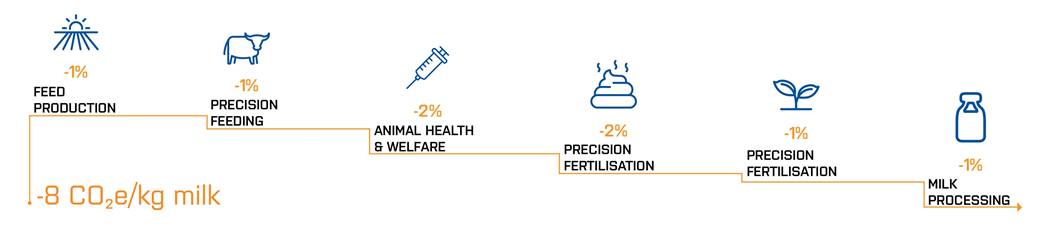
A: As already indicated, the impact is both environmental and economic. Take dairy farming as an example. With precision analytics, we are estimating 5-10% reductions in CO₂e per kilogram of milk produced by simply improving efficiency in feeding, feed production, and dairy herd management, including animal health.
For example, if a farmer increases protein content in silage by just 0.3% through better timing of harvest, it reduces the need for protein from e.g. compound feed, cutting costs and emissions. Similarly, replacing mineral fertilizer through optimized use of manure can deliver up to a 2% reduction in greenhouse gases. Another example would be analysis of milk to check for urea, which is an important indicator for the protein content in the feed and thus helps to optimize protein feeding. In terms of animal health, somatic cells can be analysed in the milk and reveal important information about the udder health status of cows. This in turn can help to optimize the health status and thus productivity of cows.
1% yield improvement by reducing the average SCC in a herd leads to a 1% emission reduction.On the economic side, this translates into lower input costs and higher yields. Processors benefit, too. They gain measurable progress on Scope 3 emissions and stronger sustainability credentials, which are critical in today’s market. And of course, animals benefit from more balanced nutrition and better health, which supports longer lifespans and reduces the need for antibiotics, contributing to the One Health agenda. More examples on the impact of data-driven optimization of milk production are presented in the figure below.
Q: Who can benefit from the innovation?
A: Virtually everyone along the agri-food value chain.
• Farmers gain directly through lower feed and fertilizer costs, improved health, and stronger profitability.
• Processors and dairy companies gain a practical way to engage with their supplier base, drive emission reductions, and report real progress toward sustainability goals.
• Advisors and veterinarians benefit from better data to guide decisions and strengthen herd management strategies.
• Labs and technology providers can expand their services around sustainability testing and traceability.
• Even consumers and retailers benefit by gaining access to dairy products with verifiably lower carbon footprints.
And ultimately, the environment benefits from reduced emissions, improved soil health, and better nutrient cycling. It’s truly a win–win model.
Q: How can its application be scaled globally?
A: The foundation is already there. Agri labs, milk testing labs, cooperatives, and advisory services exist in many regions. The key is connecting these systems and embedding sustainability data into everyday operations, and spreading the concept globally.
Scaling also means collaboration. The different stakeholders along the agri-food value chain all play a vital role in bringing these tools to more farms. With the right partnerships, the right knowledge or education, and possibly the right payment and incentive systems, we can make precision analytics a shared standard for climate-smart livestock, not just a niche practice.
At FOSS, we have been providing fast, easy-to-use, and dedicated analytical solutions since 1956, and we are ready to scale this innovation even further. Our goal is to empower every farmer and processor with the data they need to make productivity and sustainability a daily reality, not an abstract goal.
Q: How does Data support sustainability in the long run?
A: Data is the bridge between profitability and sustainability. With precision analytics, we can connect daily on-farm decisions to global climate goals, proving that smarter farming is not just possible, but practical, economical, and sustainable.
Ultimately, our mission in FOSS is to make sustainability more manageable and measurable and turn knowledge into action. When data is accessible, clear, and connected, every stakeholder can contribute to a more sustainable, resilient, and efficient food system.
About the award
FOSS has been honored by the Food and Agriculture Organization of the United Nations (FAO) with a Certificate of Appreciation for its innovation, “Precision Analytics for Climate-Smart Livestock: From Feed to Food with Cost-Effective Data.”
The recognition was announced during the Second Global Conference on Sustainable Livestock Transformation, held at FAO Headquarters in Rome. The event brought together over 1,200 global leaders, policymakers, researchers, and industry innovators under the theme “Fostering Change, Scaling Innovations, Driving Solutions.”
Chosen from more than 400 global submissions, FOSS’ innovation ranked among the top ten initiatives demonstrating tangible impact in advancing sustainable livestock. The approach showcases how cost-efficient analytical solutions can reduce emissions, improve resource efficiency, and strengthen farm profitability.