
In recent years, the dairy industry has seen dramatic increases in raw material prices and energy costs. In parallel, many highly trained professionals have taken their hair nets off for the last time to head off on well-earned retirements. Despite the best efforts of HR departments, the industry is struggling to recruit young talent to fill their place, leaving significant gaps in expertise on the production floor.
In response, it only makes perfect sense to strive for the lights out dairy approach by making the most of the latest advances in automated process control, not least, by exploiting the rapidly developing field of process analysis. As incoming milk accounts for around 50 % of production costs, this aspect of production is the obvious target for the use of process analysis in improving the outcome of the dairy process. Empowered by a constant flow of control data from the process, dairies can effectively get more from their investment in control systems by improving the use of key milk components in their products. At the same time, the dependency on manual labour and expertise on the production floor is reduced and the idea of ‘lights-out’ production takes a step closer to reality.
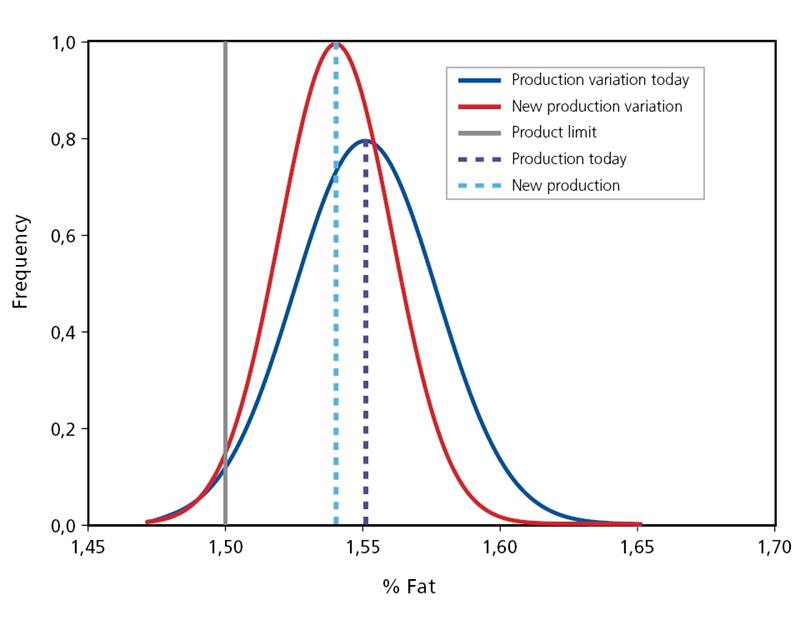
Figure 1: Visualization of process control in relation to the content of fat in milk as it flows into the dairy. The blue curve shows the original range of variation in fat. The red curve shows the reduced variation achieved with process control. This allows the production target (blue dotted line) for fat to be moved closer to the industry specification of 1.5 %. Significant gains in output can be made with no impact on quality and with no risk of overstepping the 1.5 % threshold.


