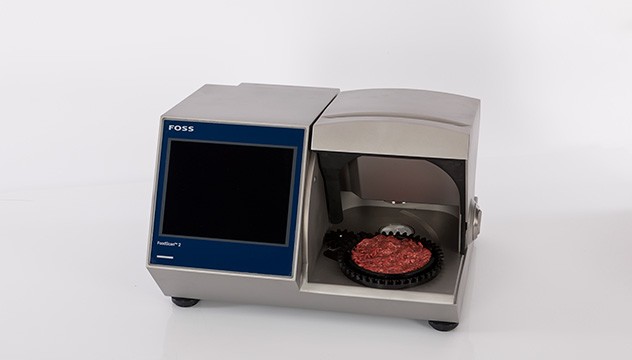
In the fast-paced world of meat production, accuracy, efficiency, and quality control are paramount. With the AOAC approved FoodScan™ 2 offering fast and easy analysis of meat products with exceptional accuracy, you get all the information you need to succeed with your process and final product control. In this article we dive into the advantages driving the industry leading accuracy of the FoodScan 2.
Deeper penetration with NIR transmission
Near-Infrared (NIR) technology has been a staple in the food industry for decades. Its ability to rapidly analyze samples has transformed quality control processes. But FoodScan 2 takes NIR to new heights covering a much larger share of the sample than other NIR solutions on the market, offering the best accuracy in meat analysis. So, how is this possible?
Unlike other NIR meat analyzers, FoodScan 2 utilizes NIR transmission rather than NIR reflectance. With NIR reflectance, the light bounces off the surface providing an assessment of the outer layer of the sample. In contrast, NIR transmission provides an assessment of the entire sample with a sample penetration of up to 20 mm.

NIR transmission:
• Light passes through 1-2 cm of the sample.
• Deep penetration ensures high repeatability and accuracy.
• Requires less homogenization
NIR reflectance:
• Light penetrates the upper few millimeters of the sample.
• Requires thorough, time-consuming homogenization to achieve good accuracy.
• Challenged by high fat content samples.
In a comparative study conducted by FOSS, the accuracy of NIR transmission and NIR reflectance was investigated.
30 ground meat samples were analyzed using each method respectively. Following NIR analysis, the samples were analysed for total fat by an accredited reference lab.
The major difference between the two ways of applying NIR is the sample representation. The FoodScan 2 scans approximately 50% of the sample content while a NIR reflectance analyzer scans the sample surface amounting to approximately 1% of the entire sample. Consequently, the FoodScan 2 NIR transmission method delivers significantly better repeatability and accuracy in meat analysis compared to NIR reflectance solutions.

The above illustration demonstrates the repeatability and accuracy of analyzing homogenized ground meat samples using FoodScan 2 and a NIR reflectance solution. The repeatability is assessed by repacking and measuring the same sample multiple times.
Compared to the transmission-based FoodScan 2 analyzer, the repack error of the reflectance analyzer was significantly higher, by a factor of more than 5-6. Unfortunately, there is no workaround to avoid the repack error.
The error/uncertainty of each NIR method is calculated as follows:
Transmission: +/- 0.2 % for fat (+/- 2*SD = 95% confidence)
Reflectance: +/- 1 % for fat (+/- 2*SD = 95% confidence)
This means that using a reflection analysis solution to analyze a meat sample consisting of 20% fat would lead to a variation of 19-21% in 95 percent of cases. With a FoodScan 2 the variation would only be 19,8 -20,2%.
Deeper penetration combined with an increase in sample points means that NIR transmission is less sensitive to inhomogeneous meat samples and requires less homogenization time compared to a NIR reflectance analyzer. Similarly, the FoodScan 2 is less sensitive to surface effects such as fat and moisture, which can skew results. With NIR transmission, FoodScan 2 minimizes these interferences, allowing meat producers to confidently assess quality without worrying about surface variations.
The power of Artificial Neural Networks (ANN)
Another powerful driver behind the leading accuracy of FoodScan 2, is the use of ANN. An Artificial Neural Network (ANN) is a ready-to-use calibration model that is based on the neural structure of the human brain, learning from vast datasets, and adapting to variations.
This means that operators can cover a large range of parameters without having to switch between individual analytics packages when testing different products and fat ranges.
ANN calibrations save time and make life easier for the operator. Real-time predictions and less need to verify calibrations mean that both validation time and the risk of operator error is minimized. When many products and parameters are involved, this aspect can save significant costs compared to using other calibration methods.
AOAC Approval: A Seal of Excellence
The crowning benefit of FoodScan 2 is the AOAC seal of approval.
The AOAC set rigorous standards for analytical methods, and this acknowledgement ensures that meat producers can trust FoodScan 2 results for regulatory compliance, quality control, and confident decision-making. FoodScan 2 is the only NIR analyser that is AOAC approved for analysis of meat products and is also approved by the Australian Quarantine and Inspection Service (AQIS) and Polska Noma in Poland.
Thanks to the power of NIR transmission, ANN calibrations, and AOAC approval, FoodScan 2 offers unprecedented levels of accuracy and efficiency that have earned it a reputation as the industry leading solution for meat analysis in today’s fast-paced world of meat production.