
The National Conference on Interstate Milk Shipments (NCIMS), in collaboration with the Food and Drug Administration (FDA), has evaluated and approved BactoScan™ 5, documented in a dedicated 2400 Form available on the NCIMS website.
This adds to the MicroVal certification BactoScan™ 5 already holds. MicroVal is a European certification organization for the validation and approval of alternative methods for the microbiological analysis of food and beverages. The MicroVal approval of BactoScan™ 5 was completed by the time of the launch in April 2025 and was carried out in accordance with ISO 16140-2:2016 Microbiology of the food chain - Method validation, ISO 16297:2020 Milk - Bacterial count - Protocol for the evaluation of alternative methods, and ISO 21187:2021 Milk - Quantitative determination of microbiological quality - Guidance for establishing and verifying a conversion relationship between results of an alternative method and anchor method results.
BactoScan™ 5 joins its predecessors, BactoScan™ FC and BactoScan™ FC+, as a rapid method carrying these major approvals.
FOSS introduced the first BactoScan in 1980, and the technology has since become an industry standard for raw milk bacteria testing, with instruments installed in dairy/milk testing laboratories worldwide. The dual MicroVal and NCIMS/FDA approval of BactoScan™ 5 extends that position to the fifth generation of the platform.
From plate count to flow cytometry
Traditionally, the reference method for bacteria in raw milk is SPC (the Standard Plate Count method) - culture the sample, incubate it, count the colonies. It requires up to 48 hours for results.
BactoScan™ 5, by contrast, uses flow cytometry technology to count individual bacteria directly and returns a result in around nine minutes, at throughputs up to 200 samples per hour, across a measuring range of 1,000 to 150,000,000 IBC/ml.
In practice, the measurement runs in four steps, as shown in the illustration below.
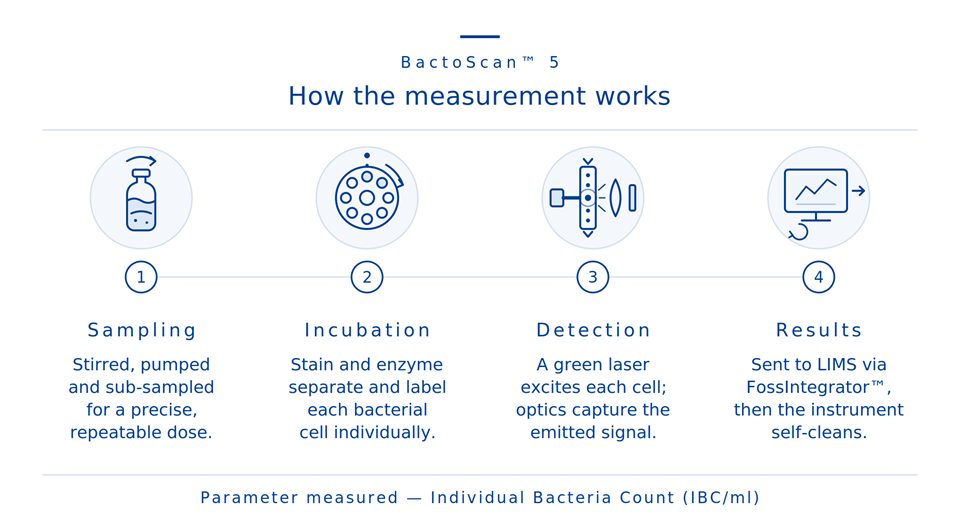
Because every cell is registered individually, the raw output is an Individual Bacteria Count (IBC/ml), which the instrument can convert to colony-forming units (CFU/ml) using a validated conversion relationship . Results can therefore be reported in either unit, whichever the regulation or payment scheme requires.
Why total bacteria count matters - and why it pays to measure it well
Total bacteria count is a key parameter in milk payment and a direct measure of the hygienic quality of raw milk. It reflects how the milk was produced, cooled, stored, and transported, and in most markets, it feeds directly into what a farmer is paid. Approvals based on testing carried out in accordance with internationally recognized standards are what allow those results to be relied on - by laboratories, dairies, and producers alike - for both food safety decisions and fair milk payment.
That reliability is only useful if it can be delivered day after day, at volume, without tying up your most experienced staff. BactoScan™ FC+ set the standard for routine total bacteria count testing; BactoScan™ 5 keeps the same proven flow cytometry principle and rebuilds everything around it.
A new reagent concept. Staining solution and enzyme are dosed automatically, cutting reagent consumption by 15–20% and removing harsh chemicals such as boric acid from the laboratory entirely. No reagents are used in standby mode.
Significantly reduced workload. Fewer manual handling and mixing steps mean less operator time each day and faster onboarding for new staff - routine payment testing no longer depends on one specialist being available.
Lower cost of ownership. Reduced reagent use, less operator time and higher uptime bring the total cost per sample down by up to 20% across the instrument's working life.
The result is the same trusted, approval-backed number underpinning milk payment - produced with less work, less waste and lower running costs.

