MENU

Take the driving seat with precision control of the fat/protein ratio in cheese milk

In today’s dairy industry every drop of milk counts in the quest for efficient production and optimal use of resources. At the same time, ensuring a healthy profit requires nerves of steel to balance increasingly fine margins between success and failure.


A strategy that has shown positive results at dairies around the globe is to achieve greater control of the fat and protein (F/P) ratio in cheese milk going into the cheese vat.


The introduction of the FOSS MilkoScan™ FT120 analyzer in 1992 provided a powerful tool to accurately standardize the F/P ratio in cheese milk. Today, the MilkoScan concept continues in a highly developed form. What’s more, an online solution based on the same technology is now available that can be placed directly in the process. The solution, called ProcesScan™ 2, delivers a result every ten seconds. This enables a high level of control of the F/P ratio and reduction in variation of the fat in dry matter (FDM) in cheese (Fig 1).


With greater predictability in the cheesemaking process, producers are empowered to optimize the use of fat in relation to protein. Producers can manage natural variations in milk composition and improve the cheese making process significantly. As shown in the profit improvement example, this leads to improved business results while maintaining high quality standards.
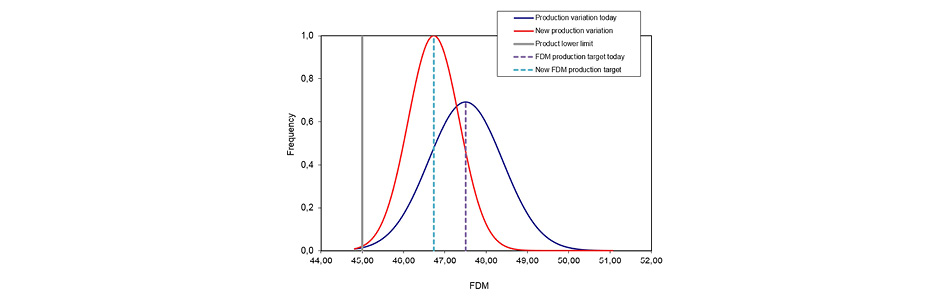
 

Fig. 1: Reduced variation in FDM. The blue curve shows the original range of variation and the red curve shows the reduced variation achieved with process control.

This allows the production target (blue dotted line) to be moved closer to the target. 


Reduction in variation of FDM and a slight increase in moisture:


  • Annual production is 15,000,000 kg cheese and the original FDM is 47.5%
  •  

  • The deviation from target is reduced by 30% allowing the target to be set at 47.1% 
  •  

  • The corresponding reduction of the FDM will lead to an increased moisture from 37.89% to 37.95%
  •  

  • Profit is improved by 150,000 Euro per year


Profit improvement example.


Online sensor improves performance while reducing dependency on skilled staff

The measurements of fat and protein are provided by a sensor (ProcesScan 2) installed in a pipe ahead of the cheese vat. The PLC can now receive results every ten seconds with the same performance as the renowned MilkoScan solution. In addition to improvements in performance, a fully-automated system for standardization of cheese milk helps cheese makers to tackle the growing challenge of finding qualified staff to run the dairy. Instead of making period tests with a desktop analyzer and adjusting the process by hand, the continuous measurements from the process feed the PLC with data to act on automatically.


Another benefit of automation is that operators can constantly monitor and control the fat and protein ratio directly in the flow into cheese vats. This just-in-time approach reduces the need to invest in extra holding tanks and leads to increased capacity. 


Where to measure

It’s the number one question in process control. And, for a good reason. Wherever the sensor is positioned, it must provide data that is actionable, otherwise the payback will be of limited or no value. But get it right and the return on investment is immediate. A classic example is the process control of fat/protein ratio of milk ahead of the cheese vat. Hear more in this short video overview.


How it works and what you need to know

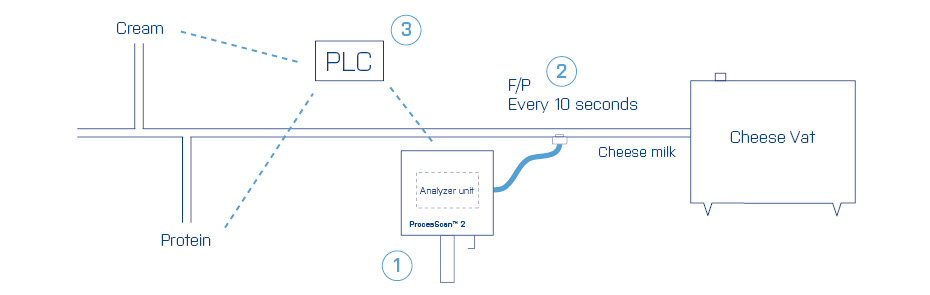
The following illustrates a typical set-up for control of the fat and protein ratio in cheese milk. A sensor is installed in a pipe close to the standardizing system and PLC reacts in real time to optimize the process. 


Cheese graph 

Fig. 2:

1. The sensor (ProcesScan™ 2) continuously samples and analyzes the standardized milk

2. The ProcesScan 2 analyzer unit uses the same technology as the renowned MilkoScan™ FT3 analyzer (FTIR technology)

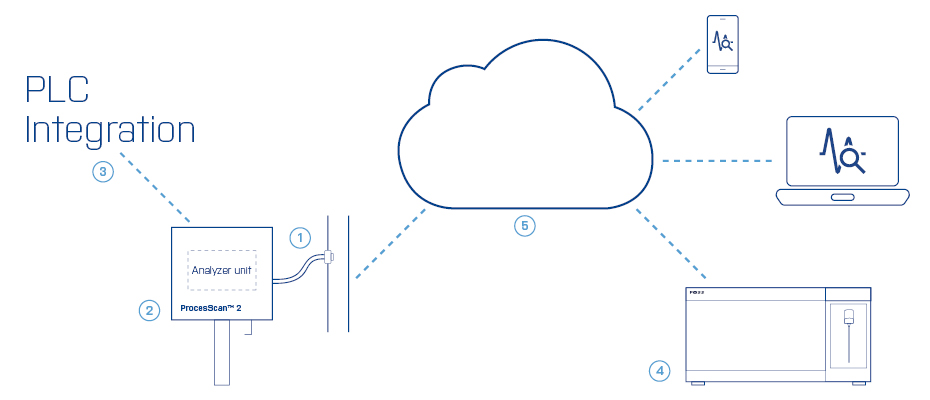
3. As part of the installation, the unit is connected to the plant’s PLC system in a closed integration using OPC UA Ethernet or Bus communication with no compromise to data security


Secure, non-cloud interface to control systems

The solution includes an in-built Linux Processor, so no extra PLC is needed to interface with a PLC or Scada system. The open platform communications (OPC) standard is used as it is one of the most important communication standards for industry 4.0.


The OPC/UA PLC interface is a state-of-the-art interface that does not involve the use of cloud technology, thereby promoting cyber security. However, there is still the option to use cloud-based services to monitor and maintain the performance of the instrument. This is because the servers can only respond to input messages and can never initiate communication with clients. Accordingly, a range of cloud-based services from FOSS can be used with top security. In this case, no data from the local control system is shared with the analysis unit which is monitored and managed online via a separate system with no interference or connection to the local control system.


High performance infrared sensor and analyzer unit

Measurements are made using fourier infrared infrared (FTIR) technology with a solution called the ProcesScan 2. FOSS has been a front runner in the application of FTIR since the 1990’s and today has become the gold standard for testing liquid samples. Today more than 80% of global milk supply is tested with FTIR technology used in FOSS MilkoScan instruments.


Exactly the same technology is used in the ProcesScan 2 solution described here except that the instrument is enclosed in robust cabinet making it insensitive to vibration, heat and humidity. Samples of milk are presented to the unit every ten seconds via a sample interface connected to the flow of milk just after the blender. 


Up and running in a few days

The FTIR technology works on fundamental information derived from the mid-infrared spectrum. This produces strong and sharp spectral peaks giving a very clear signal and making the whole process of installing and adjusting the instrument to local conditions a straightforward task. 


The calibrations (also known as analytics packages) supplied with the solution are based on a large pool of reference data, which covers a very wide variety of sample types. Only minor adjustments using local data will be required to ‘tune in’ the system to your particular production. What’s more, the stability of measurements across units makes it simple to install multiple units across different production lines. If updates to calibrations are required, for example, in response to changing raw material characteristics, this does not require a lot of work to roll-out.


Diamond sample interface avoids worry about instrument wear

The sample is analyzed directly without sample preparation and a clean of the instrument flow system is performed automatically after each test before the next is started. In the heart of the measurement system is a key component called a cuvette that ensures the correct presentation to the infrared light. A diamond cuvette is used to ensure that wear from the constant flow of samples and clean cycles does not affect results. 


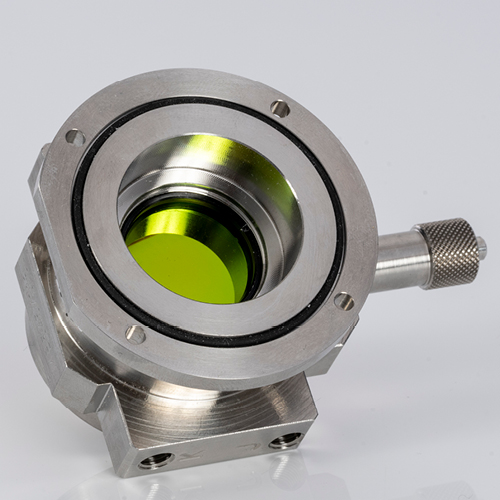
Diamond cuvette

The purpose built ProcesScan™ 2 diamond cuvette is fully integrable in all CIP routines due to a diamond cuvette and a very robust flow system.


Automatic performance check as part of every measurement

The ProcesScan 2 solution described here is a second generation of the groundbreaking ProcesScan concept originally launched by FOSS in 1999.


While working on the same principles, the new version improves the concept on many levels. One such way is that it has significantly reduced the time and expertise required to keep the instrument running exactly as it should. For instance, a manual procedure was previously required to compensate for possible impacts on analytical performance. This was typically done once or twice a month. Now the instrument does this automatically every few seconds as part of every measurement cycle. Manual work is avoided and performance is improved with a significantly reduced cost of ownership and daily work for the operators.


Simple to benchmark against gold standard reference

Performance validation is an option that allows you to validate ProcesScan 2 predictions using a FOSS benchtop analyzer such as a reference, without any manual entry of data.


Samples are measured and registered by the ProcesScan 2 and benchtop analyzer respectively to eliminate the risk of error and secure optimal performance. Using integration, connectivity and automation, the results matched are saved via cloud and are ready for evaluation and reporting using digital services.


Graph image


Fig. 3: Optional performance validation using results from FOSS benchtop analyzer as a reference.

Stay informed - with insights and news from FOSS

Stay ahead of your competitors! Get fresh knowledge and valuable insights about trends, challenges and opportunities related to analytics in your business, directly in your inbox.

Something went wrong!

Sorry, we were not able to send your form.
back to top icon
The content is hosted on YouTube.com (Third Party). By showing the content you accept the use of Marketing Cookies on Fossanalytics.com. You can change the settings anytime. To learn more, visit our Cookie Policy.