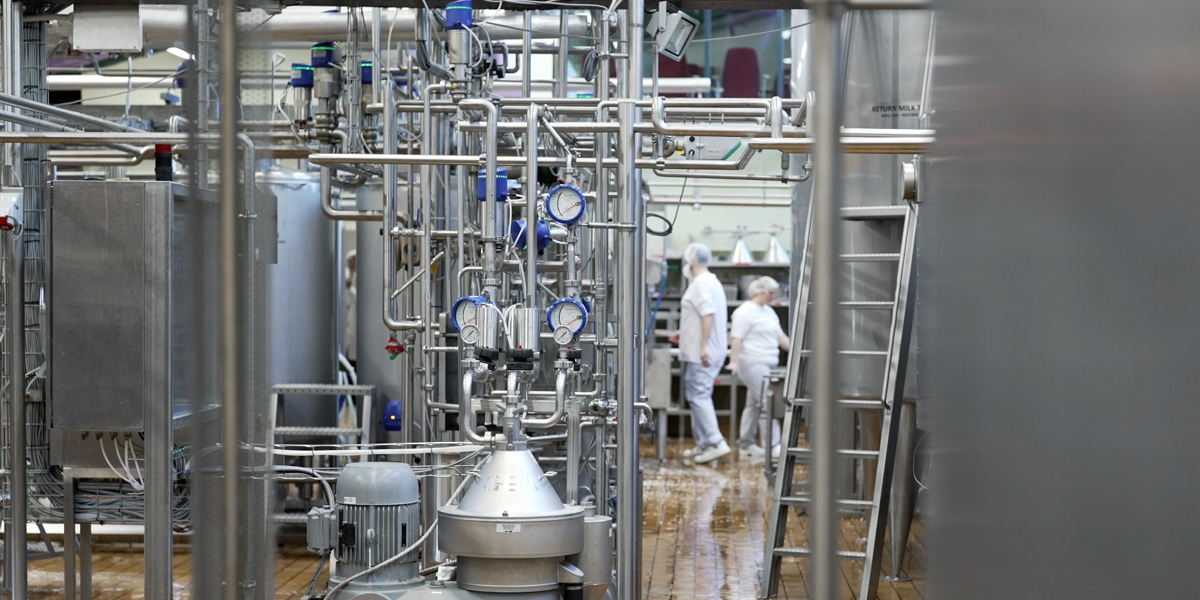
Based in New Zealand, FOSS Pacific Key Account Manager, Campbell McCracken, has over twenty years of experience in implementing Fourier transform infrared (FTIR) solutions in dairy processing environments. He has witnessed the development of FTIR testing for process control up-close and in recent months has experienced how the latest ProcesScan™ 2 now makes the process control of liquid milk an altogether smoother, more efficient and cost-effective proposition (fig 1). We caught up with him for some key questions relevant for any dairy considering a move to the latest FTIR platform for process control.

Figure 1
You have followed the story of process control with FTIR for many years. Can you briefly explain why there has been so much focus on FTIR as the right technology for the job when it comes to liquid milk?
Having experience with both near infrared (NIR) and FTIR technology for milk standardization applications, it is pretty clear to me that FTIR is superior to NIR, particularly for protein analysis in standardized milk streams. It is far easier to develop reliable, robust, global prediction models with less samples for FTIR applications, due I’m sure to the access to clear information within the mid-infrared spectra. This provides for stable, accurate calibration models, minimizing the need for frequent slope/intercept adjustment. In my experience, it is different with NIR. Calibration development requires much larger data sets and regular monitoring of instrument performance along with frequent bias adjustments to optimize instrument accuracy.
Can we describe the FOSS ProcesScan 2 as a new milestone and if so, why?
A number of points spring to mind, for example, there’s the fact that there’s a result every 10 seconds and this is based on monitoring actual milk samples taken over eight of those 10 seconds. This means we’re getting a much more representative sample compared with our previous generation product. Another highlight that must be mentioned is that the instrumentation is always standardized. Following the same principle developed with the FOSS MilkoScan™ FT3, we are constantly standardizing the instrument (at every zero setting) meaning the instrument will have zero drift. This ensures stable predictions enabling maximum yield opportunities for our ProcesScan 2 users.
New users of the ProcesScan 2 solution report that it can be up and running in as little as two days – is this really possible?
Yes. Having done a couple of installations myself, it is quite doable as long as preparations have been made at the site. This includes the production of an instrument stand, ran power and ethernet cables, water supply and the FOSS-provided varinline welded into the process pipe. If the right preparations are made, the installation can be done inside a day. Outside of that, some automation programming is required, so assuming this is done in advance of FOSS engineers arriving on site, the second day can be used to test the automation via OPC UA is working. Literally, the ProcesScan 2 could be standardizing product at the end of the second day.