For generations, Indian farmers have been relying on the traditional APMC mandis to sell their crops. The mandis are wholesale markets where farmers are selling their crops through open government-regulated auctions. The system was created by state governments in the 1950s and 1960s to ensure that farmers were safeguarded from exploitation by large retailers. In recent years, however, farmers have expressed increasing discontent about these Mandis due to lower price realization, lack of transparency, price cartelization, and low quality of mandi infrastructure.
Speaking with Himanshu Saxena, sales manager for FOSS India, he explains how the system has been facing considerable challenges. “Farmers had limited control over the pricing process and were often facing exploitation due to subjective yield realization,” he says and continues: “Many farmers that I have been speaking with, have been unhappy with the system. They have had a feeling that the pricing of their grain relied on physical subjective inspection, leading to inconsistencies and often a bias towards the traders,” he explains.
Transparency and efficiency through technology
The system that was originally set up to secure fair payment and prevent exploitation, turned out to be incomplete and hindered growth and traceability in the agricultural sector.
In 2016, the government launched E-NAM (Electronic National Agricultural Market). E-NAM is a pan-Indian electronic trading portal to create a unified national market for agricultural commodities, creating a seamless national market where buyers and sellers can transact without being in the same location and more buyers can bid for a specific product. “E-NAM emerged as a game-changer, establishing a digital platform for online auctioning of agricultural products and a better marketing platform for the farmers,” Mr. Saxena explains. “Traditionally the farmers were restricted to the closest geographical market, due to the physical auction. With E-NAM, the auction became online, which gave the farmer access to other markets. It also eliminated the information asymmetry between farmers and traders and created better and real-time price discovery based on actual demand and supply.”
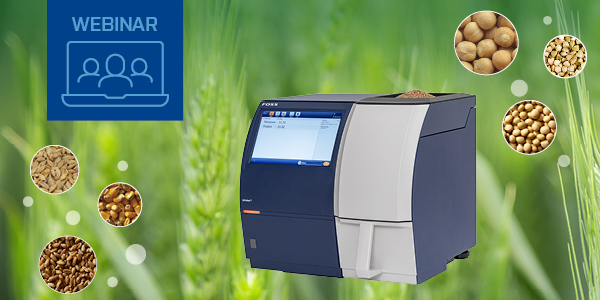
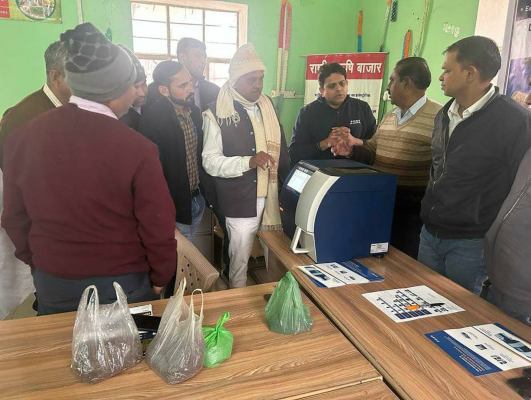
Making fair pricing based on a transparent quality grading system is a central part of the E-NAM project. “We quickly saw that FOSS had solutions that could play a central part in the project providing analytical NIR analysis for measuring key quality parameters in grain,” Mr. Saxena explains. “The collaboration started in 2020 when the government in the province of Rajasthan implemented the first Infratec™ instruments in the E-NAM project and built on the regional success, the structure is now expanding to other states.”
Creating transparency with Infratec™
The integration of FOSS Infratec with E-NAM has yielded significant benefits for both farmers and the government, Mr. Saxena explains: “Infratec truly stepped in to bridge the gap between the farmer and trader, creating objective quality analysis that ensures fair prices on yield for the farmers. Based on actual quality, the online auction now provides complete transparency,” he says and explains: “Farmers receive a slip result for reference, allowing them to verify the quality assessment, which eliminates room for manipulation,” he says and continues: “The government also benefits from the project as the E-NAM platform minimizes malpractices in the mandi system and improves efficiency providing data-driven decision making in the agricultural sector.”
Partnership in Rajasthan, India and beyond
The initial implementation of E-NAM with FOSS Infratec integration began in Rajasthan with over 97 machines installed across various mandis. This project received widespread recognition from farmers and was covered extensively by media outlets. Today, over 300 FOSS Infratec instruments are operational across multiple states, including Tamil Nadu, Karnataka, Haryana, and Uttar Pradesh. “With E-NAM actively being implemented in other Indian states, FOSS is positioned as a leading partner for the government of India in this transformative initiative,” Mr Saxena concludes.
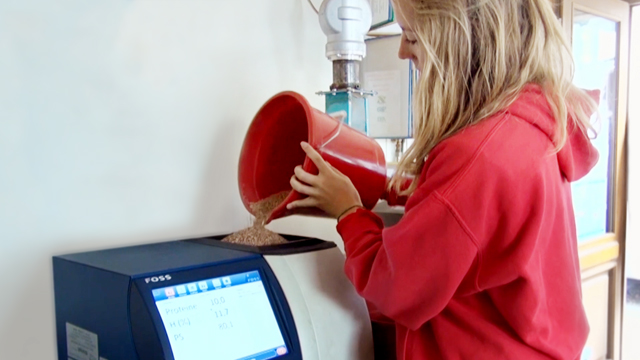
Infratec is the golden standard in the grain industry. The most well-established analytical packages are based on as many as 50.000 samples representing over 35 years of seasonal variety. The robustness of analytical packages compliments the proven NIR performance of the Infratec. With FOSS Connect and API integration, the Infratec seamlessly connects with the E-NAM portal, enabling the direct upload of yield-quality data. This offers a winning combination for reliable grain analysis